Showing posts with label powerbi. Show all posts

Friday, February 2, 2018

Use reference tables for previews in Power BI

In my quest to provide customers with awesome reports I’ve been looking at why the performance in Power BI can be so slow at times. As I pointed out in earlier posts the OData.Feed can be quite the resource hog depending on the endpoint, so I’ve started to fall back on Json.Document to get much better preview times (but not without it’s drawbacks, like record count, connected tables and option set labels).

Just because I’m kinda new to this I like to perform a lot of the logic using M in the query editor, then I sew it all together with relationships and measures inside the reports I build. I noticed that the previews kept getting slower the more I logic I added, so get the ultimate magic tool and looked at what was happening.

First step: Json.Document(Web.Contents(“https://<org>.api.crm4.dynamics.com/api/data/v8.2/opportunities”))

image

OK, so it makes a request to Dynamics and retrieves the data in 3.435 seconds. That’s not fantastic, but it’s not bad.

Second step: = Source[value]

image

OK, no requests made. That’s what I would expect from it

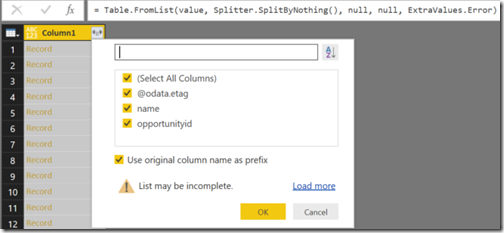
Third step: = Table.FromList(value, Splitter.SplitByNothing(), null, null, ExtraValues.Error)

image

Still no requests made, that’s great

Fourth step: = Table.ExpandRecordColumn(#"Converted to Table", "Column1", {"actualclosedate", "actualvalue", "budgetamount", "estimatedclosedate", "estimatedvalue", "name", "opportunityid", "pzl_countryregion", "statuscode"}, {"Column1.actualclosedate", "Column1.actualvalue", "Column1.budgetamount", "Column1.estimatedclosedate", "Column1.estimatedvalue", "Column1.name", "Column1.opportunityid", "Column1.pzl_countryregion", "Column1.statuscode"})

Guess what? Still no requests.

Fifth step: = Table.TransformColumnTypes(#"Expanded Column1",{{"Column1.estimatedclosedate", type date}})

No requests. Great, so we only make 1 request per step, as long as we don’t merge in more columns? Not quite.

Refresh preview

image

Wait what? 5 requests, that’s 1 request per step. That makes the loading time increase from the original 3+ seconds into well over 15 seconds. I don’t have the answer for why it makes a new request for each and every step, but let me show you the consequence of this when you use OData.Feed instead of Json.Document

These are the steps taken:

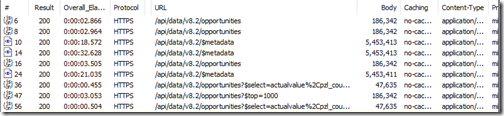
  1. = OData.Feed(https://<org>.api.crm4.dynamics.com/api/data/v8.2/opportunities)
  2. = Table.SelectColumns(Source,{"actualclosedate", "actualvalue", "budgetamount", "createdon", "estimatedclosedate", "estimatedvalue", "name", "new_calculatedrevenue", "new_product", "opportunityid", "pzl_countryregion"})
  3. = Table.TransformColumnTypes(#"Removed Other Columns",{{"createdon", type datetime}})
image

Now that should be enough to make you think twice before reporting on Dynamics data in Power BI. As you can see it’s the metadata documents which takes the longest, but for some reason there are 4 requests to the “all opportunities” endpoint and the metadata endpoint, while there are 3 requests to the opportunity endpoint with reduced number of columns (fields). Also, there is one top=1000 request which completes before the last two. This tells me that when you refresh the data, the requests are made in sequence for each step, but the steps are performed in parallel. It almost smells like premature optimization.

So let’s break this down and do it step by step.

Step 1

image

OK, great, one request for the opportunities and one for the metadata, finally one to get the top 1000 records for the preview.

Step 2

image

Now we see that it makes the same three requests as it did in the previous step, but it also performs another set of requests against “all opportunities” and metadata before it performs a request against opportunities with reduced number of columns (fields).

Step 3

image

Finally, it does all the requests from previous steps, but it also adds another duplicate for this current step (which only converts the type, and doesn’t require collecting more data from the source system).

The magic workaround

Just by pure luck, when I tested this originally I got 4 duplicates of the “all opportunities”+select requests, and I couldn’t figure out where the 4th duplicate came in. Turns out, because I made a reference from this opportunity query into a new query, and the data is refreshed in all referenced queries as well as the parent(s).

That made me test one final thing. I created a new reference query after I had done all my logic in the main query.
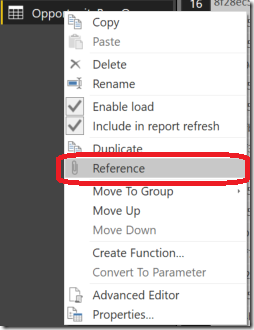
image

Then I refreshed the data while in the reference query.

Step 1: = Query1

image

VoilĂ ! Only one set of requests, even though it’s technically the fourth step.

This means I just saved myself many duplicate requests, and the data loads much faster than for each subsequent step. This was only for 3 steps, imagine how much this will matter if you have 10, or 20 steps in your queries.

The wrap up

So in summary, when you refresh the preview for a query in a Power BI, all the requests are are repeated and added on for each step you have in that query. It’s an exponential growth of data gathering, and can make everything slow as nothing else.

Creating new queries with references removes the need to duplicate all the requests, and you can keep working with and massaging the data without having to worry about minutes of data reloading.

Wednesday, January 31, 2018

How to retrieve OData v4 fast in Power BI

I recently blogged about how Power BI has a bug which ignores the select statements when querying an OData v4 endpoint. Even though the columns would include any data, it still bugged me so much that I wanted to find a way around it.

Turns out that’s much easier than you would expect.

I recently explored some of the different data loading capabilities in PBI, and it turns out that there’s a Json.Document function which allows you to handle OData at an even lower level.

So what I did was take my original uri and query string: https://<org>.api.crm4.dynamics.com/api/data/v8.2/opportunities?$select=name

Then I put it into a Json.Document(Web.Contents())

And voila, this is the result

image

Navigating into that list, you can then right click the column and select “To Table”. This will present you with a table of records ready to be exploded:

image


So, time to do a little speed testing

Using: = OData.Feed("https://<org>.api.crm4.dynamics.com/api/data/v8.2/opportunities?$select=name")

Screenshot_20180131-160714

Using: = Json.Document(Web.Contents("https://<org>.api.crm4.dynamics.com/api/data/v8.2/opportunities?$select=name"))

Screenshot_20180131-160738


Enough said?

PowerBI desktop ignores select statements in OData v4

I’ve been working a bit with Power BI and Dynamics the last few weeks, and I’ve encountered an issue which I at first thought was because of the Dynamics REST OData service. Turns out this is an issue with Power BI.
The issue is, when you specify a select statement in the query URL Power BI ignores it, and retrieves ALL the fields/columns instead.
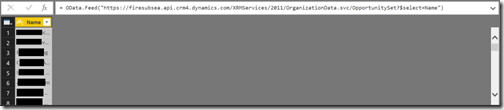
To demonstrate the issue, here is what happens when I use the old OData service from Dynamics CRM
image
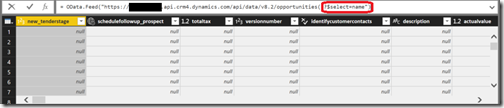
And here is what happens when I use the modern REST service
image
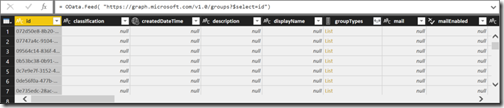
This is what happens when I try to use the graph api
image
So as you can see, when we use OData v4 endpoints the select statement is ignored, and the consequence is that all fields/columns are included. However, the columns does not include any data, so it is much faster than retrieving all columns with data.

So what can we do about it?

Nothing, for now, but if you vote for my idea to fix it we can get something soon (hopefully). Unfortunately, the Power BI community forum doesn’t integrate with Microsoft Services, so you have to create a new account (if you don’t already have one). I BEG of you to please take the time to vote
http://community.powerbi.com/t5/Issues/Select-query-in-odata-v4-is-ignored/idi-p/348974

Monday, January 29, 2018

Dynamic option sets in PowerBI

I recently had a requirement from a customer who needed to filter reports based on global option sets. The kicker for this requirement was that the option set would change rapidly for some time (don’t ask), so they needed a dynamic way to retrieve the labels and use them in a report.
Now, there are several solutions out there to retrieve the option set data, and I got some tips from the talented Ulrik “Why is he not an MVP yet” Carlsson. While his solutions work, I don’t want a static transformation in PBI, I don’t want a custom entity to store information already in the system, and I don’t want to use fetchxml as a source. Are those unreasonable demands? Maybe. Is that going to stop me? Never.
So to start with, I checked the global option set definitions for my organization, found from the following URL
https://<org>.crm4.dynamics.com/api/data/v8.2/GlobalOptionSetDefinitions
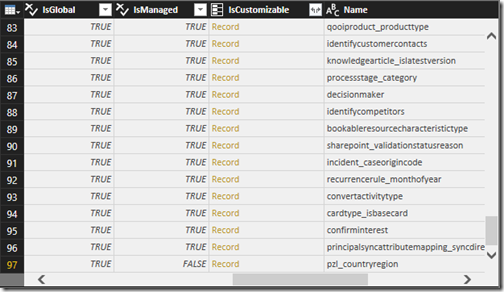
Sure enough I found all the option sets in the system, so I tried to add that url as a source in PowerBI to see if I can get the option set values. After waiting some time for it to load I can see that there are no lists or subsets to load that gives me anything useful.
image
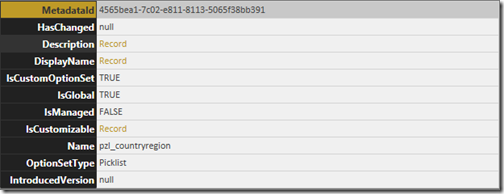
So I try to load up the direct url for the option set in question, using the metadata id of the option set. The url looks like this:
https://<org>.crm4.dynamics.com/api/data/v8.2/GlobalOptionSetDefinitions(bd3519cf-3d67-43f2-8a94-d6849872f615)
While this does give me a result, it’s not anything I can use.
image
So I load the URL into chrome to look at the data. Here I can clearly see all of the option sets, complete with locales and values. That means that the data is available, but I am not getting it in the format I want.

Alternative 1, parse the content as a JSON document

Instead of using an OData.Feed to load the data, I can just take the specific optionset metadata and load it into a Json.Document instead. To do this, create a new blank query, then paste the following value
= Json.Document(Web.Contents("https://<org>.crm4.dynamics.com/api/data/v8.2/GlobalOptionSetDefinitions(bd3519cf-3d67-43f2-8a94-d6849872f615)
This will provide you with “Options” as an attribute which contains a list of records. You can then click on the List to navigate to it.
image
You now get a list of records, where you can right click the column and select “To Table”. This will convert the list into a table, and from here you can expand the columns. I chose to expand Value and Label, as that will give me the option set int value and the label string. The label is a record itself, so you have to expand it to get more options. The choices here is LocalizedLabels and UserLocalizedLabel. The difference being that the LocalizedLabels contains all the labels for all the localizations defined in your system, while the UserLocalizedLabel contains only the label for the user’s language.
image

UserLocalizedLabel

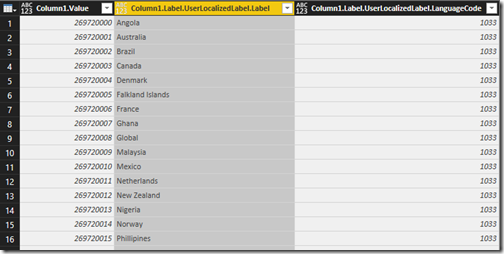
Expanding the UserLocalizedLabel gives us a new record, which we then can expand to Label, LanguageCode, and other additional metadata attributes. I’ve chosen to expand the first two, and we now have a useable table with both int values as well as label strings in the user’s language
image
You can now rename the columns and use them to join with the primary records in your PBI report.

LocalizedLabels

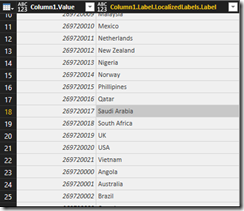
Expanding the LocalizedLabels will give us lists of labels for each value. You can’t expand a list to new columns straight away, so you will have to expand the table with new rows. If you have additional languages, which is probably why you’re doing this, then you will duplicate the integer values for all option set values that have several language definitions.
In my example I’ve just duplicated the table because I don’t have multiple languages enabled, so don’t worry about duplicate values, it’s on purpose.
image
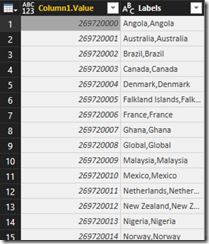
So the next step is to right click the Column1.Value column, and select group by. Give the new column a sensible name (I named mine labels), then choose operation “Max” and select the label column as the column. This is just to get a basis for the grouping.
Now, in the next stage, the formula should look somewhat like this:
= Table.Group(#"Appended Query", {"Column1.Value"}, {{"Labels", each List.Max([Column1.Label.LocalizedLabels.Label]), type text}})
You need to change it so it looks like this instead:
= Table.Group(#"Appended Query", {"Column1.Value"}, {{"Labels", each Text.Combine([Column1.Label.LocalizedLabels.Label], ","), type text}})
The result will look something like this:
image
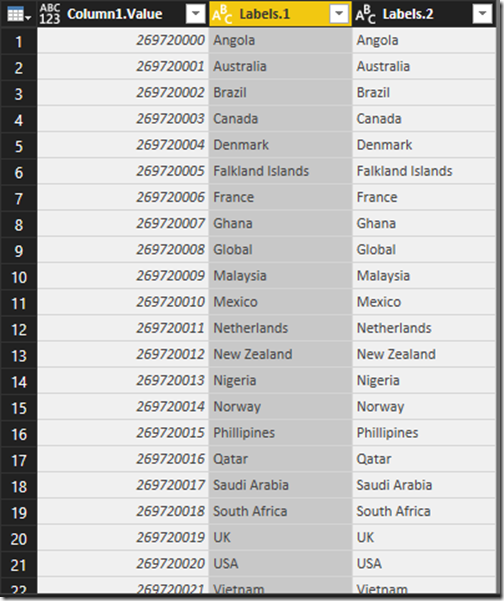
Now, right click the Labels column and select “Split Columns” –> “By delimiter”. Choose to split each occurrence. The resulting table now looks like this:
image
You can now give the columns sensible names and use them in your PBI report.

Alternative 2, add query options to get the list of labels

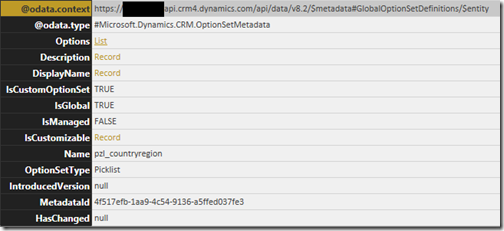
The other solution to retrieve the odata feed is to add additional columns. As we saw earlier the OData.Feed(… just gave us metadata about the entity, but none of the options. This is because the options, which includes data, is excluded by default. To include them in the query simply change the source definition from this:
= OData.Feed(https://<org>.crm4.dynamics.com/api/data/v8.2/GlobalOptionSetDefinitions(4565bea1-7c02-e811-8113-5065f38bb391))
To this:
= OData.Feed(https://<org>.crm4.dynamics.com/api/data/v8.2/GlobalOptionSetDefinitions(4565bea1-7c02-e811-8113-5065f38bb391), null, [MoreColumns = true])
The “null” is for additional headers, while the second is a PBI record which states that MoreColumns should be true (default false). All the available options are specified in the following article https://msdn.microsoft.com/en-us/library/mt260868.aspx
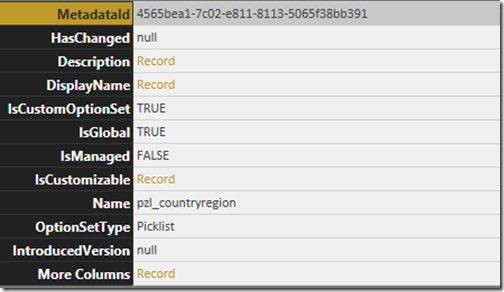
The result of this is the following screen.
image
We now have an attribute named “More Columns”. Clicking on that will navigate into the record, which is a list of records. Right click the column and choose “To Table”. You will now have a table where you can expand the columns just like specified in alternative 1.

Wrap up

Getting option set labels isn’t obvious when you’re creating reports in Power BI thanks to how attributes and attribute metadata is defined in Dynamics 365. Luckily there are ways to retrieve additional data in a dynamic way which allows us to utilize the system in awesome ways.
Until next time!